Background
Oakland’s Grand Ave. Complete Streets program aims to improve traffic safety for bicyclists, pedestrians, and other traffic users. These goals are achieved by slowing down traffic in key corridors via the implementation of traffic calming measures. This particular intersection is also a part of Oakland’s Lakeside Family Streets. Although the new infrastructure does improve the chances of reduced speeds, there are still potential conflicts that could be fatal.
Bike Lane
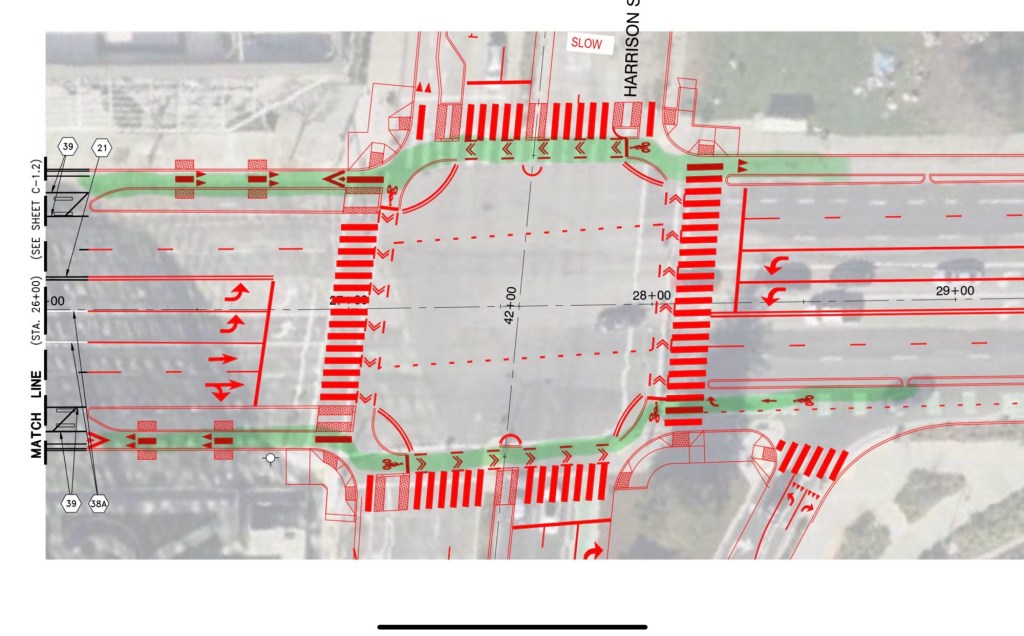
The bike lanes run in all directions through the intersection. The east and westbound lanes are highlighted above. These improvements meet the Manual on Uniform Traffic Control Devices (MUTCD) and Federal Highway Administration’s (FHWA) mandatory guidelines and also incorporate optional design features such as green bike lanes, intersection markings with some areas functioning like bike-boxes.
The new design eliminated the previous marge lane that saw traffic conflicts between buses and the bus stop at the corner, personal vehicles, and cyclists.

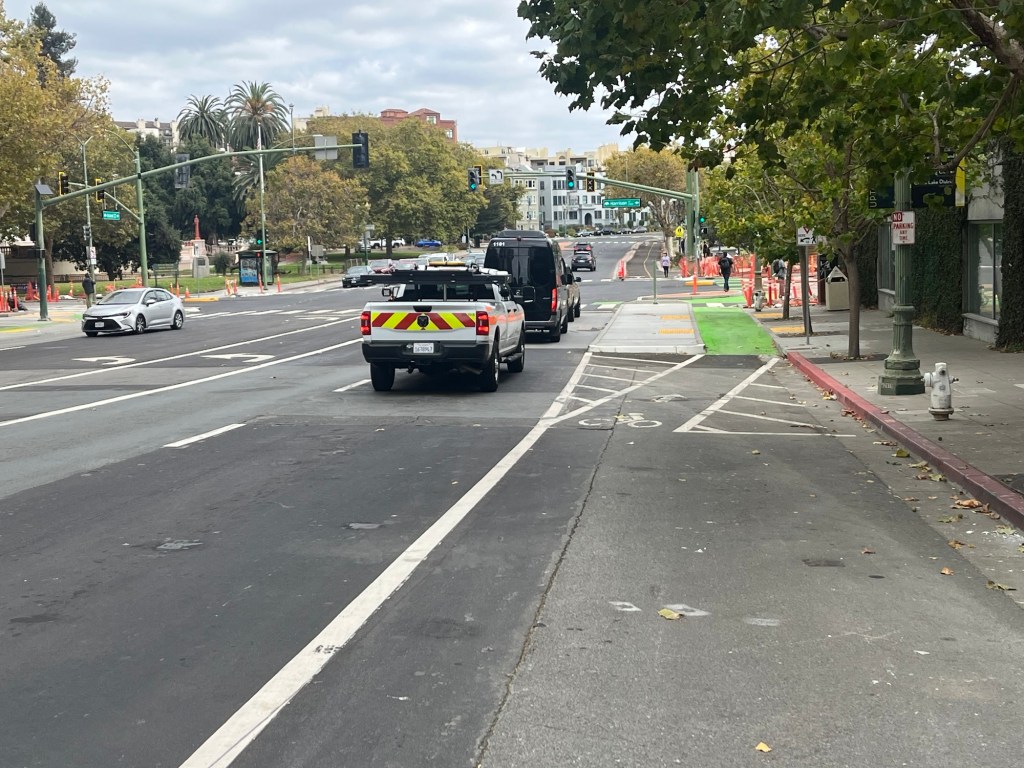
There is greater separation of traffic modes with buses and other vehicles now having to share the right lane, even during bus pick-up and drop-offs. The bike lane is given a protected right shoulder and pedestrians have access to a wide sidewalk. By creating this protected lane for cyclists, vehicles must now make a wider right turns. Although these improvements create separation, there are still design features that limit bicycle throughput and create new potential risks.
The improvements maintain bicycle lane continuity but the bicycle lane includes chicanes that introduce new risks. The bicycle lane has two chicane’s, one on each side of the intersection. This impedes bicycle throughput and is most restrictive when traveling eastbound on Grand Ave. due to the downhill gradient and higher bicycle speeds. Greater braking is needed to navigate the chicanes and avoid potential pedestrian and traffic conflicts. These features aim to increase safety via reduction of speeds instead of maintaining smooth uninterrupted bicycle travel lanes through the intersection and this is due to the bus stop at the intersection.

Risky bulb-outs. At night or when visibility is low, the bulb-out at the corner protrudes into a cyclists path. As mentioned above, with a cyclist traveling at a greater speed due to the downhill gradient of Grand Ave., they are put at a potential risk and required to navigate the chicane without hitting the bulb-out. There is a non-zero probability of a cyclist not seeing the bulb out in time and crashing, and having their momentum carry them into the traffic lane or intersection. If a car is making a right turn or traveling through the intersection at this time, the accident could be fatal.
The right turn conflict is worsened. A second point with potential conflict is the right turn. When traffic is stopped, cyclists will not have clear visibility of stopped cars, nor will they be able to see cars turning right because the protected green bike path will be treated like a bike box, and the cyclist will be stopped further ahead of traffic. One instance where a vehicle and bike collsion could prove fatal is if a light turns green and a cyclists begins to pedal from a stand still while a car traveling down Grand Ave. is entering the intersection with speed, the vehicle will have a decreased chance of seeing the cyclist due to the chicane because the bicyclist will be further ahead and further to the right. The cyclist will be vulnerable and unable to see the car approaching from behind and turning right. If a car is navigating the right turn and notices the bulb out, there will be a moment when their attention will be focused on not hitting the bulb-out and taken not on a cyclist traveling in the bike lane.

The radius of the curve for turning vehicles is also hazardous for vehicles. As mentioned above, the bulb-out may distract the driver turning right. The nature of the bulb out is such that cars, especially longer vehicles, have difficulty turning around two apexes. Even though the construction was recently completed, there are already visible tire marks shown on the bulb-outs.

In conclusion, the traffic measures are effective at separating vehicle traffic from bicycle and pedestrians but create other problems. Vehicle throughput is hindered due to the shared bus stop at the intersection on Grand Ave. east bound. Bicycle throughput is also hindered due to the chicanes at the intersection. The bulb out also poses a hazard to cyclists because it protrudes into the cyclists’ path continuity. The cyclists also must be more acutely aware of cars turning right due to staggered stop positions. The design features do not make for smooth traffic flow through the intersection for vehicles turning right and cyclists traveling straight through the intersection. An intersection with more obstacles does not make an intersection more safe.
It would be more ideal to have the bike lane be protected, continuous, and straight through the intersection while having vehicles reduce their speed when making right turns.
 Zacksunsang